Register No. 1 — Founding cohort, opened MMXXVI
Real connections between serious professionals.
The useful parts of professional networking, without the cringe-pseudo social feed, the fake influencers, and the one-way pitch slaps. The Registry is built on a single standard: seriousness and intent, not current title.
Direct contact is gated. You can reach someone only when a mutual connection sponsors the introduction and the other party consents. Two opt-ins, one sponsor, one specific ask.
The founding cohort is being seeded now. We release twenty-two invitations a month, each reviewed by hand.

What this is built on
The opposite of what LinkedIn became.
LinkedIn trained a generation to scroll, collect, and perform. The Registry is built on the opposite instincts.
Reach with intent
Read what matters, when you choose to.
Admission by sponsor
Every member arrives through a standing invitation.
Warm introductions
Contact travels through someone who knows both parties.
Quality over count
One meaningful introduction beats a thousand cold requests.
Record over performance
What you have done and what you are open to is the message.
The formula
Double opt-in by default.
Step 01
Find the route
Open a member's entry. The Registry shows the standing connections you share, so every introduction starts from a real point of trust.
Step 02
The sponsor passes it
Your stated purpose goes to that mutual connection first. They pass it forward when it feels right — their own standing is why the request gets taken seriously.
Step 03
The welcome reply
Only then does the other party see it, and only if they welcome it does a channel open. Both sides opt in, so every conversation starts with a yes.
A sponsor passes only what they would want to receive themselves. That small filter is why inboxes stay useful, and why a reply here is more likely than a cold pitch ever was.
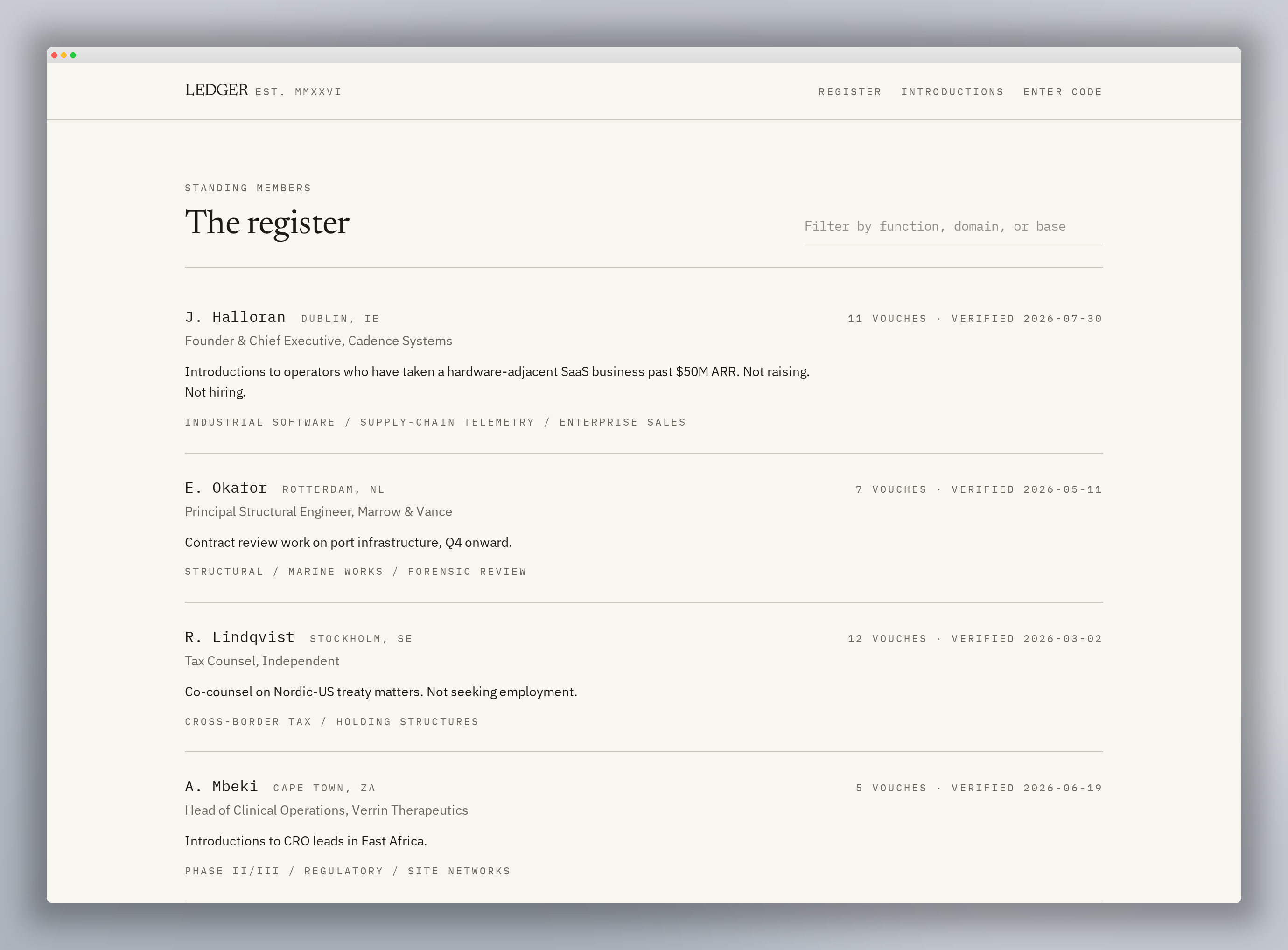
Inside the register
One page per member. No feed to scroll.
Each entry states function, base, verified record, and the one thing that person is currently open to. You read it in seconds and know whether an introduction is worth anyone’s time.
How your network works
Start small. Grow by invitation only.
When you join The Registry you do not get a global directory. You get your network: the member who admitted you, their standing connections, and the people reachable through them. That is it.
A new account looks limited on purpose. Your first connection is the sponsor who issued your code. Their first-degree connections become your second-degree reach. When you issue your own invitations, your network expands with every person you vouch for.
No leaderboard, no public count, no master list. The only way to see someone is through a real chain of trust.
The alternative
LinkedIn lost the plot.
LinkedIn started with great purpose: a place to record your professional record and stay reachable for real opportunity. But somewhere along the way it got confused about what it was trying to do and became the ultimate cringe: a social network for workers, artificially blending the lines between friendship, teammate, and stranger.
At The Registry, we take a professional realistic view. We do not pretend you are friends with your coworkers. We do not force you to post, like, or perform. We treat reputation as a scarce asset and contact as a privilege, not a button.
The result is a network where one meaningful introduction beats a thousand cold connection requests.
Who is on the register
Names withheld until admission- J. HalloranFounder & Chief ExecutiveBoston, MAVerified 2026-07-30
Open to: Introductions to operators who have taken a hardware-adjacent SaaS business past $50M ARR. Not raising. Not hiring.
- E. OkaforPrincipal Structural EngineerHouston, TXVerified 2026-05-11
Open to: Contract review work on port infrastructure, Q4 onward.
- R. LindqvistTax CounselChicago, ILVerified 2026-03-02
Open to: Co-counsel on US-Canada treaty matters. Not seeking employment.
- A. MbekiHead of Clinical OperationsRaleigh, NCVerified 2026-06-19
Open to: Introductions to CRO leads in the Southeast US.
What a member is open to is public here; who they are is not. Names, records, and the route to an introduction appear once you are inside.
Before you file
The questions people actually ask.
- What does it cost?
- Nothing. There is no fee, no upgrade, and no paid tier during the founding cohort. The price of entry is being someone another member will vouch for.
- Who reads my application?
- A person, not a filter. Applications are read in batches against the composition of the register, and every decision is made by hand.
- What happens to my details?
- They stay in the admissions file. Nothing you write on the application is published, sold, or shown to members. If you are admitted, you write your own entry from scratch and decide what appears.
- Why join a register this early?
- Because early members shape who comes next. Every member holds invitations, so the first cohort effectively writes the second. That leverage does not exist later.
- I am between roles. Is that a problem?
- No. The standard is seriousness and intent, not current title. A specific ask from someone between roles beats a vague one from someone with a title. There is a page on how candidacy works here.
- How long does review take?
- Applications are read in the monthly cycle. If a place is offered you receive a single-use code by email; if not, your application stays on the roll for the next cycle.
Twenty-two places a month. The application takes two minutes.
Eight short fields and one honest sentence about what you want an introduction for. No fee, no profile to build, and nothing published unless you are admitted and write your own entry.